
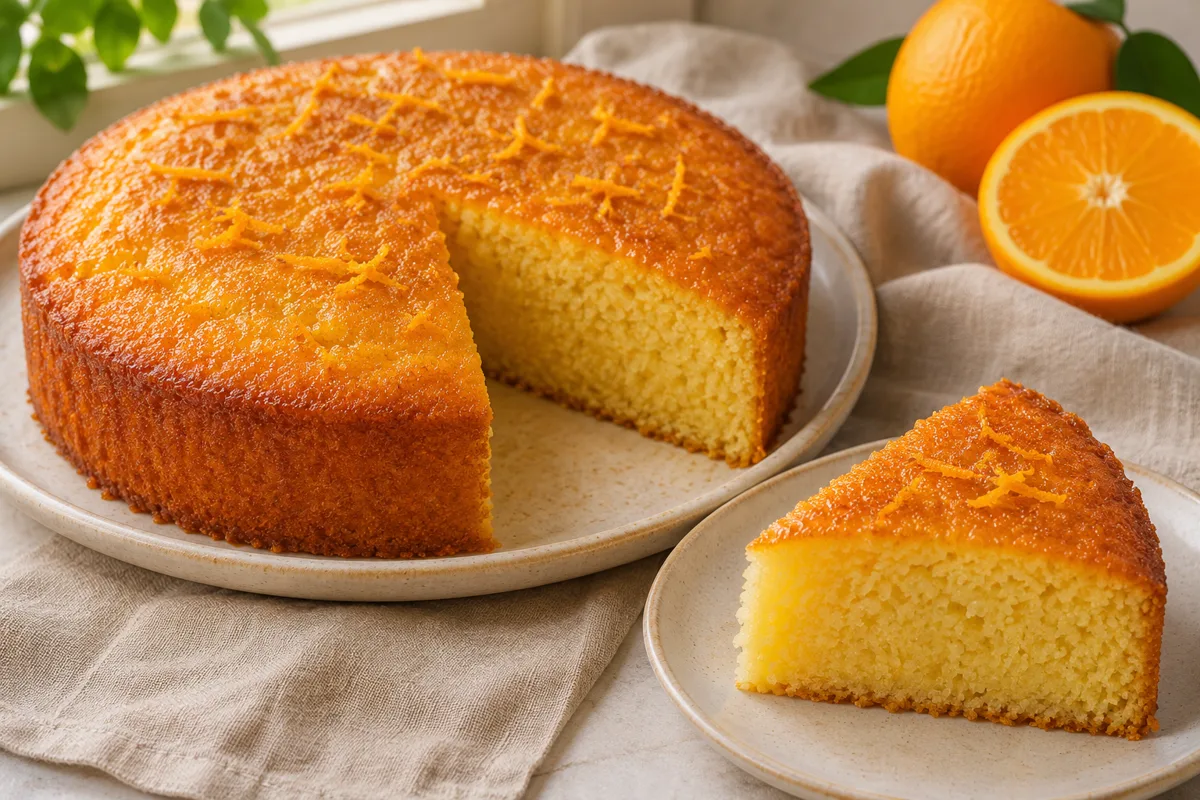
Serving illustration; presentation may vary.
This orange yogurt semolina cake has a fine, slightly sandy crumb, a gentle citrus fragrance and a thin syrup that adds moisture without leaving a pool underneath. It is a simple round cake for slicing rather than an elaborately decorated dessert. Yogurt, oil and fresh orange zest do most of the work, with a small amount of flour helping the crumb hold together.
Semolina absorbs liquid differently from plain flour. A short rest after mixing gives the grains time to hydrate before the batter enters the oven. That pause is useful: it makes the batter more consistent and reduces the temptation to add extra flour because it seems loose immediately after mixing.
The syrup is deliberately modest. It should moisten the warm cake in stages, not turn it into a saturated pudding. This formulation takes inspiration from yogurt and semolina cakes made in several cuisines, without presenting itself as one specific traditional regional version. Use the measured quantities and pan size first, then explore variations once you know the intended texture.
Orange Yogurt Semolina Cake with Light Orange Syrup
Recipe at a glance
Makes one 20 cm/8-inch round cake, about 10 slices. Preparation: 20 minutes. Batter rest: 10 minutes. Baking: 35–40 minutes. Cooling before slicing: at least 45 minutes. Total: approximately 1 hour 55 minutes. Difficulty: easy to moderate. Equipment: a fixed-base 20 cm round cake tin at least 5 cm deep, baking parchment, scales, whisk and small saucepan.
Ingredients
For the cake
- 150 g fine semolina, approximately 3/4 cup plus 2 tablespoons depending on brand
- 80 g all-purpose flour, about 2/3 cup, spooned and levelled
- 2 teaspoons baking powder, approximately 8 g
- 1/4 teaspoon fine salt
- 2 large eggs, about 100 g without shells
- 120 g caster or granulated sugar, about 1/2 cup plus 1 tablespoon
- 200 g plain unsweetened yogurt, about 3/4 cup plus 1 tablespoon
- 90 ml neutral oil, 6 tablespoons
- 60 ml fresh orange juice, 1/4 cup
- Finely grated zest of 1 large orange, about 2 teaspoons
- 1 teaspoon vanilla extract, optional
- A little oil for the tin
For the light syrup
- 80 ml fresh orange juice, 1/3 cup
- 40 g granulated sugar, about 3 tablespoons plus 1 teaspoon
- 1 teaspoon fresh lemon juice
Metric weights are the reference quantities. Semolina grain size and the way flour is packed affect cup measurements, so baking scales give more dependable results. Use fine semolina rather than coarse couscous, polenta or semolina pudding mix with added sugar. Plain yogurt should be pourable but not watery; very thick strained yogurt may change the batter’s consistency.
Step-by-step method
- Heat the oven to 180°C/350°F conventional, or 160°C fan. Lightly oil the cake tin and line its base with baking parchment. Set the tin on a flat baking tray if that makes it easier to transfer without tilting the batter.
- Whisk the semolina, flour, baking powder and salt in a bowl until evenly combined. Break up visible lumps of flour. This distributes the raising agent before the dry mixture meets the wet ingredients.
- In a second bowl, whisk the eggs and sugar for about one minute, until combined and slightly lighter. You do not need a thick ribbon or a large volume of foam. Whisk in the yogurt, oil, orange juice, zest and optional vanilla until the mixture is uniform.
- Add the dry ingredients to the wet bowl. Fold with a spatula or whisk gently only until no dry patches remain. Scrape the bottom of the bowl, where flour can hide. Leave the batter for 10 minutes while the oven finishes heating.
- Stir the rested batter gently once and scrape it into the prepared tin. Level the top without pressing out every small bubble. Bake on the middle shelf for 35–40 minutes, beginning to check at 32 minutes if your oven tends to run hot.
- The cake is ready when its centre springs back gently and a skewer inserted into the middle comes out without wet batter. A few moist crumbs are acceptable. If the surface colours before the centre sets, cover loosely with foil and continue baking, checking again after several minutes.
- During the final baking minutes, combine the syrup ingredients in a small saucepan. Heat gently, stirring until the sugar dissolves, then simmer for one minute. Remove from the heat. The syrup should be fluid, not reduced into a thick glaze.
- Leave the baked cake in its tin for 10 minutes. Make evenly spaced holes across the surface with a thin skewer, reaching partway through the crumb. Spoon the warm syrup over in three additions, waiting for absorption between them. Stop if liquid remains pooled rather than pouring in the rest automatically.
- Leave the cake in the tin for a further 20 minutes, then loosen the edge and carefully transfer to a rack. Let it cool for at least another 15 minutes, preferably until only slightly warm, before slicing. A warm syrup-moistened cake is more fragile than a fully cooled one.
Choosing the right semolina
Fine semolina gives a closer crumb than coarse semolina. Packages use different names, so inspect the grains rather than relying only on the word semolina. The texture should resemble fine sand. Large couscous grains do not dissolve into this batter and cannot be substituted using the same method.
The short hydration rest helps the grains take up liquid. Do not leave the mixed batter on the counter for an hour, because the baking powder has already met moisture and its performance may change. Have the tin ready and the oven nearly at temperature before mixing. Ten minutes is a practical pause, not an overnight soaking step.
If you only have a coarse product, it is better to choose a recipe developed for that grain size than to add extra liquid without testing. Different semolina types can also absorb slightly differently. Write down the brand and result if you plan to refine the cake for regular use; that is more useful than changing three ingredients at once.
Orange flavour without bitterness
Wash and dry the orange before zesting. Remove only the coloured outer layer with a fine grater, rotating the fruit as you go. The white pith underneath tastes more bitter and does not add the same fragrance. Grating directly over the mixing bowl helps capture the aromatic oils that otherwise remain on the board.
Use juice strained of seeds and large pulp pieces. Very sweet oranges produce a gentler syrup, while tart oranges give a sharper finish. Taste the juice before starting so its flavour is not a surprise. The teaspoon of lemon juice in the syrup adds a small balancing note; it is not intended to make the cake distinctly lemon-flavoured.
Orange blossom water is an optional variation rather than a required ingredient. If using it, add only 1/2 teaspoon to the finished syrup after removing it from the heat. Products differ in intensity, and too much can make the cake taste perfumed. Do not replace the measured orange juice with orange blossom water.
Mixing and oven checks
The batter does not need prolonged beating. After the flour is added, mixing until smooth enough is sufficient. Excessive mixing can develop more structure than this tender cake needs. A few tiny semolina grains remain visible and should not be mistaken for dry flour that must be whisked away.
Pan size affects baking time. A wider tin creates a shallower cake that may bake faster and absorb syrup differently. A smaller tin creates a thicker centre that may remain undercooked while the edges brown. Use the specified 20 cm tin for the first version. Avoid converting directly to a loaf tin without treating it as a separate trial.
An oven thermometer can help if cakes repeatedly darken or sink. Opening the door very early can also disturb a still-setting centre. Begin checks near the end of the expected baking window, then use the skewer and spring-back cues together. A golden top alone is not proof that the centre is baked.
Applying syrup without a soggy base
The cake should be warm rather than straight from the oven when you add syrup. Its surface has had time to settle, but the crumb can still take up liquid. Small holes help distribute the syrup through the top instead of leaving it only around the outside edge.
Spoon slowly and move around the surface. Pouring the full amount into the centre encourages a wet patch. If absorption slows, wait briefly before adding more. Differences in semolina, baking time and evaporation mean the cake may not need the final spoonful. A little unused syrup is preferable to a collapsed, saturated middle.
Keep the cake in its tin during this stage. Turning it out first makes it easier to crack while warm and gives liquid a route onto the worktop. A fixed-base tin also avoids syrup leaking through a loose base. If using a springform tin, check its seal and protect the surface beneath it.
Variations, serving and internal links
For a simpler finish, omit any extra decoration and let the golden top show. A few fine strips of orange zest are enough if you want colour. Do not add chopped nuts unless you intend to introduce another allergen and adjust the written ingredient and image information accordingly.
You can replace vanilla with a small pinch of ground cardamom for a different fragrance. Begin with 1/4 teaspoon so it supports the citrus. Replacing all the orange juice with lemon juice makes the recipe substantially more acidic and is not an equivalent substitution. For a lemon cake, use a formulation balanced for lemon from the outset.
Serve modest slices with tea or coffee, or add fresh fruit at the table. If offering yogurt or cream alongside, keep it refrigerated until serving and account for the additional dairy. Explore our Dessert collection for more baking ideas, or browse Breakfast recipes for a weekend table.
Storage and allergens
Once cool, store covered in the refrigerator at 4°C/40°F or below and use within three days. Bring only the slices you need towards serving temperature briefly; return the rest promptly. For longer storage, freeze individual unadorned slices wrapped well for up to one month for best quality, then thaw in the refrigerator.
There is no need to reheat, but a slice can be warmed gently if desired. Avoid heating the whole cake repeatedly, which dries the outer crumb and encourages unnecessary temperature changes. Any dairy accompaniment should be stored separately. Discard food that has been left unrefrigerated beyond appropriate perishable-food limits rather than relying on syrup as a preservative.
Contains wheat, egg and milk. Semolina is wheat and is not gluten-free. Replacing only the flour with a gluten-free flour does not make this cake gluten-free. Dairy-free yogurt and egg substitutions change moisture and structure and have not been validated for this formulation. Nutritional figures are omitted rather than presenting unsupported calorie estimates.
Frequently asked questions
Can I use Greek yogurt? Very thick strained yogurt may make the batter thicker. The reference recipe uses ordinary plain yogurt, so use that first rather than compensating with an unmeasured splash of liquid.
Why did the centre sink? Possible causes include underbaking, an overly small tin, inaccurate raising-agent measurement or disturbance before the centre set. Check those before adding more flour next time.
Can I skip the syrup? You can, but the cake will be less moist and less citrus-forward. Treat it as a different finish and check baking carefully to avoid dryness.
Why does it crumble when sliced? It may still be warm, or the grains may not have hydrated well. Let it cool and use a thin sharp knife, wiping between cuts.
Keep the finish light
Measure the semolina, give the batter its short rest and judge baking by the centre. Add syrup gradually, then let the cake settle before cutting. Those simple checks produce a citrus cake whose flavour and crumb remain clear without a heavy topping.